
Cybersecurity
Cybersecurity Guidelines
Corporate Management / Information Security Promotion
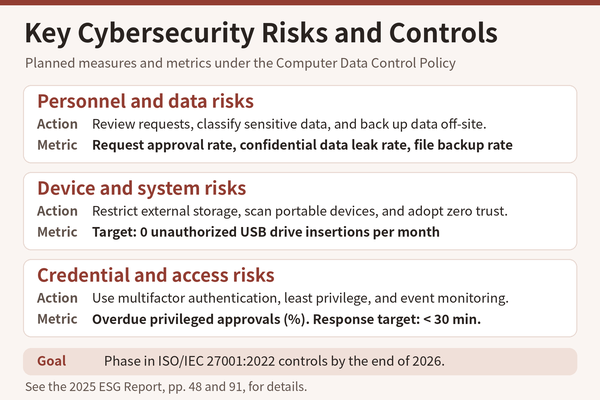
- Establish a dedicated IT department, appointing both a department head and frontline IT personnel to regularly review and implement information security policies.
- Responsibilities of frontline IT staff include: software-related operations; the inventory, development, and maintenance of systems (such as ERP and MES); office automation (OA); program maintenance; risk assessment; security protection (including troubleshooting, firewall configuration, and resolving anomalies); management of outsourced IT consultants; and incident reporting and response.
- Responsibilities of the IT department head include: diagnosing the root causes of issues escalated by frontline staff; analyzing and addressing major information security incidents; and reporting such incidents to the Chairman for the purpose of issuing significant corporate announcements.
Staff training / Staff training
- Security promotion:All employees reveive information security training every year,and dedicated personnel receive professional courses.
- The cybersecurity training content for 2025 is outlined in the table below:
Course Category Key Course Content Duration Advanced Courses – Information Security 1. Information Risk Assessment and Risk Control
2. Protection Strength
3. Threat Countermeasures and Cloud Security127 Hours - Social Engineering Drills:Examples Conduct annual email drills to educate and train those who mistakenly open emails.
Technical Support / Technical Resources
- Network segmentation: Separate development,testing and formal operating environments,and establish protective measures.
- protective measures: Use anti-virus software,intrusion detection,AI WAF website application firewall,etc.
- Data protection: Establish data encryption,access permissions, transmission encryption and other measures.
- System security detection:regularly perform vulnerability scanning,penetration testing, and source code security detection.
- Monitoring measures: Establish monitoring measures for authentication failures,access failures,etc., and protect log records.
Cybersecurity
Overview of Cybersecurity Protection Software
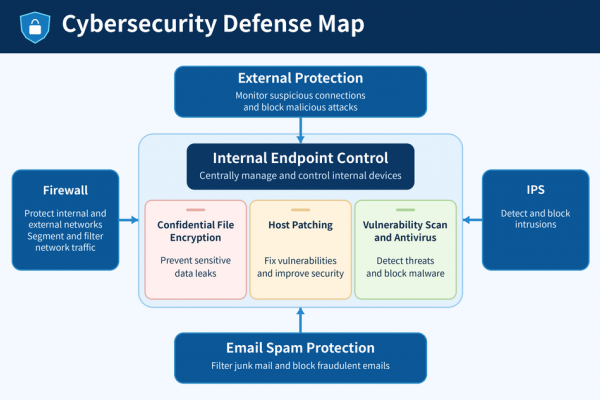
Information Security Defense Map – Description of Components
I. Core Architecture
1. Internal Endpoint Control
Centralized management and oversight of company computers, laptops, and other endpoint devices to ensure compliance with information security policies, thereby reducing the risks of unauthorized access and data leakage.
II. Four Key Defense Mechanisms
1. Endpoint Connection Control:
Manages network and peripheral connection permissions for internal endpoints, restricting unauthorized devices and preventing them from accessing the corporate network.
2. Confidential File Encryption – Preventing Data Leakage:
Encrypts critical files and sensitive data to mitigate the risk of unauthorized access or data leakage during storage, transmission, or sharing.
3. Host Patching – Vulnerability Remediation:
Regularly checks for and applies security updates to operating systems and applications, patching known vulnerabilities to minimize opportunities for hackers to exploit system weaknesses.
4. Antivirus – Protection and Threat Blocking:
Utilizes antivirus software and regular virus definition updates to detect, isolate, and block viruses, Trojans, and malicious software, reducing the risk of endpoint infection.
III. External Defense Mechanisms
1. External Protection – Monitoring and Blocking:
Monitors and secures traffic and connections entering the corporate network from external sources, detecting anomalous activity and blocking suspicious or unauthorized access.
2. Firewall – Network Protection, Isolation, and Filtering:
Enforces network access rules to regulate data transmission and connection permissions between internal and external networks, blocking unauthorized or insecure network traffic.
3. IPS (Intrusion Prevention System) – Intrusion Detection and Prevention:
Analyzes network traffic in real-time to identify suspicious attack patterns, proactively blocking malicious connections and intrusion attempts.
4. SPAM – Spam Filtering and Fraudulent Email Protection:
Through email security filtering mechanisms, the system identifies and blocks spam, phishing emails, and fraudulent messages, thereby reducing the risk of users inadvertently clicking on malicious links or compromising their account credentials.
IV. Summary of the Comprehensive Protection Framework
The information security protection map centers on "internal endpoint control." By integrating four key internal defense mechanisms with external network security measures, it establishes a multi-layered information security management framework that operates from the inside out.
Overall Objective: Establish a comprehensive defense-in-depth mechanism to ensure the confidentiality, integrity, and availability of the organization’s information assets, and to reduce the risk of information security incidents.
I. Core Architecture
1. Internal Endpoint Control
Centralized management and oversight of company computers, laptops, and other endpoint devices to ensure compliance with information security policies, thereby reducing the risks of unauthorized access and data leakage.
II. Four Key Defense Mechanisms
1. Endpoint Connection Control:
Manages network and peripheral connection permissions for internal endpoints, restricting unauthorized devices and preventing them from accessing the corporate network.
2. Confidential File Encryption – Preventing Data Leakage:
Encrypts critical files and sensitive data to mitigate the risk of unauthorized access or data leakage during storage, transmission, or sharing.
3. Host Patching – Vulnerability Remediation:
Regularly checks for and applies security updates to operating systems and applications, patching known vulnerabilities to minimize opportunities for hackers to exploit system weaknesses.
4. Antivirus – Protection and Threat Blocking:
Utilizes antivirus software and regular virus definition updates to detect, isolate, and block viruses, Trojans, and malicious software, reducing the risk of endpoint infection.
III. External Defense Mechanisms
1. External Protection – Monitoring and Blocking:
Monitors and secures traffic and connections entering the corporate network from external sources, detecting anomalous activity and blocking suspicious or unauthorized access.
2. Firewall – Network Protection, Isolation, and Filtering:
Enforces network access rules to regulate data transmission and connection permissions between internal and external networks, blocking unauthorized or insecure network traffic.
3. IPS (Intrusion Prevention System) – Intrusion Detection and Prevention:
Analyzes network traffic in real-time to identify suspicious attack patterns, proactively blocking malicious connections and intrusion attempts.
4. SPAM – Spam Filtering and Fraudulent Email Protection:
Through email security filtering mechanisms, the system identifies and blocks spam, phishing emails, and fraudulent messages, thereby reducing the risk of users inadvertently clicking on malicious links or compromising their account credentials.
IV. Summary of the Comprehensive Protection Framework
The information security protection map centers on "internal endpoint control." By integrating four key internal defense mechanisms with external network security measures, it establishes a multi-layered information security management framework that operates from the inside out.
| Protection Layer | Key Controls | Primary Objective |
|---|---|---|
| Centralized Management | Internal endpoint controls | Centrally manage and control endpoints |
| Endpoint Protection | Connection controls, file encryption, patch management, and antivirus protection | Protect devices and critical data |
| Network Protection | External network monitoring, firewalls, and intrusion prevention systems (IPS) | Block external attacks and unauthorized access |
| Email Protection | Spam filtering | Reduce spam and the risk of email fraud |